
Οι ELLENIC TRADITIONAL PROJECT στο στούντιο ετοιμάζουν το επόμενο τραγούδι τους
ELLENIC TRADITIONAL PROJECT in the studio they are preparing their next song
Are you ready?


Οι ELLENIC TRADITIONAL PROJECT στο στούντιο ετοιμάζουν το επόμενο τραγούδι τους
ELLENIC TRADITIONAL PROJECT in the studio they are preparing their next song
Are you ready?

ΒΡΑΚΑ / VRAKA
Greek traditional song from Cyprus.
Music & Video Arts by Nikolas Gkinis
DESPINA MATRAKA & MARIA PADELAKI:vocals
ANDREAS PAPAS:perc.
GIORGOS MARINAKIS:violin
ALEXANDROS ARKADOPOULOS:clarinet,flute
VASILIS SALTIKIS:sax.
KOSTAS STRATIGOPOULOS:guitar
N.GKINIS:guitars,synth.,bass,lute,lafta
Video painting by MIRABELLO
Α, σαράντα πήχες δίμιτο, σαράντα πήχες δίμιτο
σου φτιάξανε μια βράκα, σου φτιάξανε μια βράκα
Α, και σειέσαι και λυγίζεσαι
και περπατάς στη στράτα
Η όμορφη σου βράκα που κάνει τρίκι-τράκα
και ποιος θα σου την πλύνει τη βράκα σου στη λίμνη
και ποιος θα την απλώσει στον ήλιο να στεγνώσει
και ποιος θ’ ανάψει σίδερο να σου την σιδερώσει
την όμορφη σου βράκα που κάνει τρίκι-τράκα
Α, όταν σε βλέπω κι έρχεσαι
απο την μεγάλη στράτα
Α, με γιαλιστά ποδήματα
και την καινούργια βράκα
Την όμορφη σου βράκα…

Music & Arts by Nikolas A Gkinis
Vocals : Theologos Anagnostopoulos, Georgia Anagnostopoulou, Georgios Anagnostopoulos
N.Gkinis: Guitars, bass, synth, programming / recording / mixing
G.Anagnostopoulos:Violin
Painting by MIRABELLO
Αχ, δε μου λέτε, πού `ν’ αυτός ο ντόκτορ
που γιατρεύει τις πληγές, αμάν ντόκτορ,
που γιατρεύει τις πληγές.
Για να γιάνει και τις εδικές μου
που σαν τις μετρήσεις κλαις,
αμάν ντόκτορ.
Αμάν, οι πληγές μου, μένα είναι μεγάλες
και δεν έχουν γιατρειά, αμάν ντόκτορ,
και δεν έχουν γιατρειά.
Η αγάπη μου με απαρνήθη
και δε με θυμάται πια,
αμάν ντόκτορ.
Αμάν, αμάν ντόκτορ, πες μου τι κάνω,
δεν αισθάνομαι καλά, αμάν ντόκτορ,
δεν αισθάνομαι καλά.
Πάρε γρόσια, πάρε όσα θέλεις
να μου γιάνεις την καρδιά,
αμάν ντόκτορ.
Ah, won’t you tell me, where is that doctorwho heals wounds, aman doctorwho heals woundsso he can heal mine,which if you count them you cryaman doctor …Aman, my wounds, they are greatand they cannot be healed, aman doctor,they cannot be healed.My love has rejected meand doesn’t remember me anymore,aman doctor.Aman, aman doctor, tell me what to doI don’t feel well, aman doctor,I don’t feel well.Take piasters, take as many as you want,to heal my heart,aman doctor.

(translation: Eva Johanos*aman ~ interjection of grief, pain, as «Alas!»**ntoktor ~ this spelling reflects the Greek spelling of a foreign word beginning with the hard «d» sound («doctor») which is not a consonant found in the Greek alphabet; it also signals connection to the Greeks of Asia Minor***piaster ~ ancient Turkish coin, also the term «chrima» or money is used in this recording)

DESPINA MATRAKA & MARIA PADELAKI:Vocals
ANDREAS PAPAS:Perc.
GIORGOS MARINAKIS:Violin
ALEXANDROS ARKADOPOULOS:Clarinet, Flute
YIANNIS NIKOLETOPOULOS:el.perc.
N. GKINIS:Guitars, Synth., Bass, Lute, Lafta
Video Painting by MIRABELLO
*Special thanks to ‘’Aerial viewing of Greece’’ video & art producers.

All musical arranging /Video ART/ Recording & Producing
by Nikolas Gkinis
MARIA PADELAKI & DESPINA MATRAKA:Vocals
ANDREAS PAPAS: Perc.
GIORGOS MARINAKIS: Violin
ALEXANDROS ARKADOPOULOS: Clarinet, Flute
N.GKINIS: Guitars, Synth., Bass, Lute, Lafta
Video Painting by MIRABELLO
https://www.youtube.com/watch?v=vqn9zI5Xp7w
Θαλασσάκι
Θάλασσα, θάλασσα τους
θαλασσινούς θαλασσάκι μου
μη τους θαλασσοδέρνεις,
θαλασσώνουμε για σένα
ξημερώνουμαι.
Ροδόσταμο, ροδόσταμο να γίνεσαι
ωχ κι αμάν αμάν,
τη ρότα τους να ραίνεις
θαλασσάκι μου και φέρε
το πουλάκι μου.
Θάλασσα κι αλμυρό νερό
να σε ξεχάσω δεν μπορώ.
Να σε ξεχάσω δεν μπορώ
θάλασσα κι αλμυρό νερό.
Θάλασσα, θάλασσα που τον
έπνιξες ωχ κι αμάν αμάν
της κοπελιάς τον άντρα,
θαλασσάκι μου και φέρε
το πουλάκι μου.
Κι η κοπελιά κι η κοπελιά
είναι μικρή θαλασσάκι μου
και δεν της παν τα μαύρα
θαλασσάκι μου και φέρε
το πουλάκι μου.
Θάλασσα κι αλμυρό νερό
να σε ξεχάσω δεν μπορώ.
Να σε ξεχάσω δεν μπορώ
θάλασσα κι αλμυρό νερό.
Sea, sea,
the sea-faring ones ,
my little sea
Do not be turbulent for them.
We become sea-bound;
for you,
we stay awake.
Sea and salt water,
I am unable to forget you.
Rose water,
rose water will you become,
oh! alas, alas,
in order to sprinkle their door,
my little sea,
and to bring my little bird to me.
Sea, sea which has drowned,
oh! alas, alas,
the young girl’s girl’s husband,
my little sea,
and bring my little bird to me.
And the girl,
and the girl is young,
oh! alas, alas, and black,
does not become her,
my little sea,
and bring my little bird to me.

Αχ! Η ξενιτιά το χαίρεται
Τζιβαέρι μου
Το μοσχολούλουδο μου
Σιγανά και ταπεινά
Αχ! Εγώ ήμουνα που το ‘στειλα
Τζιβαέρι μου
Με θέλημα δικό μου
Σιγανά πατώ στη γη
Αχ! Πανάθεμά σε ξενιτιά
Τζιβαέρι μου
Εσέ και το καλό σου
Σιγανά…
Ah!
Αχ!
Foreignness rejoices
Η ξενιτιά το χαίρεται
My Jivaeri
Τζιβαέρι μου
My nutmeg
Το μοσχολούλουδο μου
Slowly and humbly
Σιγανά και ταπεινά
Ah!
Αχ!
I was the one who sent it
Εγώ ήμουνα που το ‘στειλα
My Jivaeri
Τζιβαέρι μου
By my own will
Με θέλημα δικό μου
Suddenly I step on the ground
Σιγανά πατώ στη γη
Ah!
Αχ!
I was deported abroad
Πανάθεμά σε ξενιτιά
My Jivaeri
Τζιβαέρι μου
You and your good
Εσέ και το καλό σου
Slowly and humbly
Σιγανά και ταπεινά
Ah!
Αχ!
Where did you get my baby?
Που πήρες το παιδάκι μου
My Jivaeri
Τζιβαέρι μου
And you did it yourself
Και το ‘κανες δικό σου
Suddenly I step on the ground
Σιγανά πατώ στη γη
ΨΑΡΟΠΟΥΛΑ – PSAROPOULA (The small fishing boat from HYDRA Island-Αργοσαρωνικός)
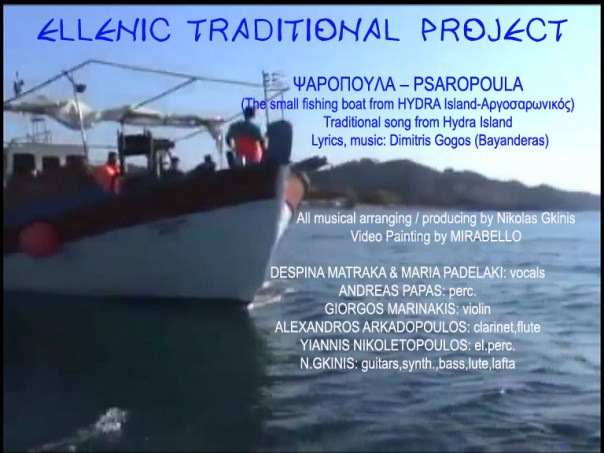
Παραδοσιακό Ύδρας
Στίχοι, μουσική: Δημήτρης Γκόγκος (Μπαγιαντέρας)
Traditional song from Hydra Island
Lyrics, music: Dimitris Gogos (Bayanderas)
All musical arranging / producing by Nikolas Gkinis
Video Painting by MIRABELLO
DESPINA MATRAKA & MARIA PADELAKI: vocals
ANDREAS PAPAS: perc.
GIORGOS MARINAKIS: violin
ALEXANDROS ARKADOPOULOS: clarinet,flute
YIANNIS NIKOLETOPOULOS: el.perc.
N.GKINIS: guitars,synth.,bass,lute,lafta
Ξεκινάει μια ψαροπούλα
απ’ το γιαλό
απ’ το γιαλό
Ξεκινά μια ψαροπούλα
απ’ την Ύδρα τη μικρούλα
και πηγαίνει για σφουγγάρια
όλο γιαλό
όλο γιαλό
Έχει μέσα παλληκάρια
απ’ το γιαλό
απ’ το γιαλό
Έχει μέσα παλληκάρια
που βουτάνε για σφουγγάρια
γιούσες κι όμορφα κοράλλια
απ’ το γιαλό
απ’ το γιαλό
Έχει Συμιακούς Καλύμνιους
απ’ το γιαλό
απ’ το γιαλό
Έχει Υδραίους και Ποριώτες
Αιγινίτες και Σπετσιώτες
που `ναι όλοι παλληκάρια
απ’ το γιαλό
μες στο γιαλό
Γεια χαρά σας παλληκάρια
και στο καλό
και στο καλό
Γεια χαρά σας παλληκάρια
να μας φέρετε σφουγγάρια
γιούσες κι όμορφα κοράλλια
απ’ το γιαλό
απ’ το γιαλό
A lovely folksong from the beautiful island of Hydra- one of the closer small islands to Athens, where I enjoyed many wonderful stays at the great arhontiko (a grand old mansion) that had belonged to a famous ship owner and had been donated to the National School of Fine Arts as a «station» where young painters could go on a painting holiday. . . such beautiful memories- so blessed!!! ❤
Fishing Boat
A fishing boat sets out
from the coast
from the coast
A fishing boat sets out
from little Hydra*
and goes out for sponges
all along the coast
all along the coast
It is full of palikaria**
from the coast
from the coast
It is full of palikaria
who dive for sponges
yuses*** and beautiful corals
from the coast
from the coast
There are men from Symi and Kalymnos****
from the coast
from the coast
There are men from Hydra and Poros
Aegina and Spetses*****
who are all palikaria
from the coast
on the coast
Health and joy to you,****** palikaria
and bring sponges for us
yuses and beautiful corals
from the coast
from the coast
Health and joy to you, palikaria
and have a good trip*******
and have a good trip
Health and joy to you, palikaria
and bring sponges for us
yuses and beautiful corals
from the coast
from the coast
(translation: Eva Johanos
*a small island not far from Athens
**plural of palikari, young man- with a connotation of strength, bravery, good character and good looks- a typical Greek youth!
***plural of yusa, a Turkish word for a kind of black coral
****two of the “Dodecanese” islands, a group of twelve major islands and many smaller ones
*****four of the “Saronic” islands, named for their location in the Saronic Gulf, close to the Attic Peninsula
****** “Yeia kai hara”- a common farewell greeting
******* “Sto kalo”- another farewell greeting, meaning literally “To the good!”)

(Song for the Sea)
Παραδοσιακό – Κυκλάδες – Αιγαίο
Traditional Song from Cyclades Islands – AEGEAN
Music & Arts by Nikolas Gkinis
Maria Pandelaki, Despina Matraka: Vocals
Andreas Papas: Percussion
Giorgos Marinakis: Violin
Alexandros Arkadopoulos: Flute, Clarinet
N.Gkinis: Guitar, synth.,Bass, Lute, Lafta
Video Painting by MIRABELLO
Θάλασσα, θάλασσα, τους
θαλασσινούς, θαλασσάκι μου
μη τους θαλασσοδέρνεις
θαλασσώνουμαι,
για σένα ξημερώνουμαι.
Θάλασσα κι αλμυρό νερό
να σε ξεχάσω δε μπορώ.
Ροδόσταμο, ροδόσταμο
να γίνεσαι, ωχ αμάν αμάν
την πόρτα τους να ραίνεις,
θαλασσάκι μου,
και φέρε το πουλάκι μου.
. Θάλασσα κι αλμυρό νερό
να σε ξεχάσω δε μπορώ.
Δείτε την συμμετοχή των Ellenic Traditional Project στο INDEPENDENT GLOBAL ART FESTIVAL στις Βρυξλελλες, μαζί όλους με τους καλλιτέχνες που συμμετείχαν.

https://www.facebook.com/watchparty/1896463133829073/?entry_source=MESSENGER_XMA
https://www.facebook.com/watchparty/1896463133829073/?entry_source=MESSENGER_XMA

Traditional Macedonian song (Macedonia, Greece)
Music arr. & Arts by Nikolas A Gkinis
Vocals by Theologos Anagnostopoulos & Georgia Anagnostopoulou
Video: https://youtu.be/QG4scS4o_cg
Παραδοσιακό τραγούδι της Ημαθίας – Νάουσας που αναφέρεται στην καταστροφή της πόλης στις 13 Απριλίου 1822 από τους Τούρκους εξαιτίας της επανάστασης που έγινε, συνάμα με την Επανάσταση στην υπόλοιπη Ελλάδα.
Χορεύεται στην μνήμη των γυναικών που έπεσαν στον ποταμό «Αράπιτσα», το 1822 – ως άλλες Σουλιώτισσες – προκειμένου να μην ατιμαστούν από τους Τούρκους.
A Greek folk song of central Macedonia and especially of the region of Emathia. It refers to the destruction of the town of Naousa in 1822 by Turks.
The habitats did a Revolution because of the big Revolution of Greeks,
but this revolution failed and the town of Naousa got destroyed.
MAKRΥNITSA
Three little birds, aman aman**
were sitting
at the castle of Niaoussa,
my Makrynitsa -deep sorrow that my heart holds [To]
One I speak, and [to] another I speak,
Night has come,
and where will I stay
One faced, aman aman,
Vodena (Edessa), the second Salonika,
my Makrynitsa, -deep sorrow that my heart holds [To]
One I speak, and [to] another I speak,
Night has come,
and where will I stay
The third, and- aman aman-
the smallest sings of song of mourning,
saying my Makrynitsa
deep sorrow that my heart holds:
They crushed us underfoot, aman aman,
at Naousa the legendary town,
my Makrynitsa deep sorrow that my heart holds.
*Traditional song of the Ιmathia region of central Macedonia and the town of Naousa, referring to the destruction and massacre of the city on the 13th of April 1822 by the Turkish occupying forces, because of the revolution that was happening, simultaneous to the War of Independence (Revolution) throughout the whole of Greece.
It is danced in memory of the women who threw themselves from a cliff into the river Arapitsa- killing themselves and their babies- as did the Souliotisses in another part of Greece- rather than to be dishonored and become the captive slaves of the Turks. Makrynitsa is the name of an important town at the top of Mount Pelion, commanding a view of the surrounding regions, to which survivors of the massacre retreated. **aman aman- a traditional expression of intense grief or regret, in speech and song
The video includes a traditional dance which is performed at the city of Naoussa commemorating the slaughter, as well as photographs of artwork memorializing the event, including a plaque which reads:
«Passerby Stand in reverence to the memory of the dead In the chasm which opens before you they found a glorious and heroic death the women and children of Naousa for Freedom and independence on the 22nd of April, 1822.»)
«Διαβάτη Στάσου με ευλάβεια στη μνήμη των νεκρών Μέσα στο βάραθρο που ανοίγει μπροστά σου Βρήκαν ένδοξο και ηρωικό θάνατο Οι γυναίκες και τα παιδιά της Νάουσας για την Ελευθερία και ανεξαρτησία του Ελληνικού έθνος στις 22 Απριλίου του 1822.»
Special thanks to:
 ...............'Ellenic Traditional Project'.......... Nikolas A Gkinis