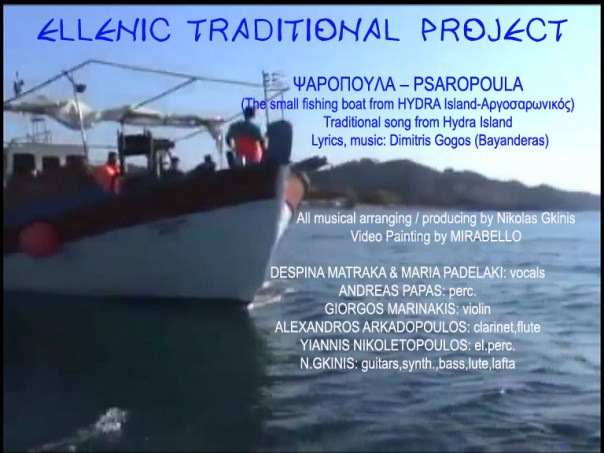
ΨΑΡΟΠΟΥΛΑ – PSAROPOULA (The small fishing boat from HYDRA Island-Αργοσαρωνικός)
ΨΑΡΟΠΟΥΛΑ – PSAROPOULA »Ellenic Traditional Project
Παραδοσιακό Ύδρας
Στίχοι, μουσική: Δημήτρης Γκόγκος (Μπαγιαντέρας)
Traditional song from Hydra Island
Lyrics, music: Dimitris Gogos (Bayanderas)
All musical arranging / producing by Nikolas Gkinis
Video Painting by MIRABELLO
DESPINA MATRAKA & MARIA PADELAKI: vocals
ANDREAS PAPAS: perc.
GIORGOS MARINAKIS: violin
ALEXANDROS ARKADOPOULOS: clarinet,flute
YIANNIS NIKOLETOPOULOS: el.perc.
N.GKINIS: guitars,synth.,bass,lute,lafta
Ξεκινάει μια ψαροπούλα απ’ το γιαλό απ’ το γιαλό
Ξεκινά μια ψαροπούλα απ’ την Ύδρα τη μικρούλα και πηγαίνει για σφουγγάρια όλο γιαλό όλο γιαλό
Έχει μέσα παλληκάρια απ’ το γιαλό απ’ το γιαλό
Έχει μέσα παλληκάρια που βουτάνε για σφουγγάρια γιούσες κι όμορφα κοράλλια απ’ το γιαλό απ’ το γιαλό
Έχει Συμιακούς Καλύμνιους απ’ το γιαλό απ’ το γιαλό
Έχει Υδραίους και Ποριώτες Αιγινίτες και Σπετσιώτες που `ναι όλοι παλληκάρια απ’ το γιαλό μες στο γιαλό
Γεια χαρά σας παλληκάρια και στο καλό και στο καλό
Γεια χαρά σας παλληκάρια να μας φέρετε σφουγγάρια γιούσες κι όμορφα κοράλλια απ’ το γιαλό απ’ το γιαλό
A lovely folksong from the beautiful island of Hydra- one of the closer small islands to Athens, where I enjoyed many wonderful stays at the great arhontiko (a grand old mansion) that had belonged to a famous ship owner and had been donated to the National School of Fine Arts as a «station» where young painters could go on a painting holiday. . . such beautiful memories- so blessed!!! ❤
Fishing Boat
A fishing boat sets out from the coast from the coast
A fishing boat sets out from little Hydra* and goes out for sponges all along the coast all along the coast
It is full of palikaria** from the coast from the coast
It is full of palikaria who dive for sponges yuses*** and beautiful corals from the coast from the coast
There are men from Symi and Kalymnos**** from the coast from the coast
There are men from Hydra and Poros Aegina and Spetses***** who are all palikaria from the coast on the coast
Health and joy to you,****** palikaria and bring sponges for us yuses and beautiful corals from the coast from the coast
Health and joy to you, palikaria and have a good trip******* and have a good trip
Health and joy to you, palikaria and bring sponges for us yuses and beautiful corals from the coast from the coast
(translation: Eva Johanos *a small island not far from Athens **plural of palikari, young man- with a connotation of strength, bravery, good character and good looks- a typical Greek youth! ***plural of yusa, a Turkish word for a kind of black coral ****two of the “Dodecanese” islands, a group of twelve major islands and many smaller ones *****four of the “Saronic” islands, named for their location in the Saronic Gulf, close to the Attic Peninsula ****** “Yeia kai hara”- a common farewell greeting ******* “Sto kalo”- another farewell greeting, meaning literally “To the good!”)
Παραδοσιακό τραγούδι της Ημαθίας – Νάουσας που αναφέρεται στην καταστροφή της πόλης στις 13 Απριλίου 1822 από τους Τούρκους εξαιτίας της επανάστασης που έγινε, συνάμα με την Επανάσταση στην υπόλοιπη Ελλάδα. Χορεύεται στην μνήμη των γυναικών που έπεσαν στον ποταμό «Αράπιτσα», το 1822 – ως άλλες Σουλιώτισσες – προκειμένου να μην ατιμαστούν από τους Τούρκους.
A Greek folk song of central Macedonia and especially of the region of Emathia. It refers to the destruction of the town of Naousa in 1822 by Turks.
The habitats did a Revolution because of the big Revolution of Greeks,
but this revolution failed and the town of Naousa got destroyed.
MAKRΥNITSA
Three little birds, aman aman**
were sitting
at the castle of Niaoussa,
my Makrynitsa -deep sorrow that my heart holds [To]
One I speak, and [to] another I speak,
Night has come,
and where will I stay
One faced, aman aman,
Vodena (Edessa), the second Salonika,
my Makrynitsa, -deep sorrow that my heart holds [To]
One I speak, and [to] another I speak,
Night has come,
and where will I stay
The third, and- aman aman-
the smallest sings of song of mourning,
saying my Makrynitsa
deep sorrow that my heart holds:
They crushed us underfoot, aman aman,
at Naousa the legendary town,
my Makrynitsa deep sorrow that my heart holds.
*Traditional song of the Ιmathia region of central Macedonia and the town of Naousa, referring to the destruction and massacre of the city on the 13th of April 1822 by the Turkish occupying forces, because of the revolution that was happening, simultaneous to the War of Independence (Revolution) throughout the whole of Greece.
It is danced in memory of the women who threw themselves from a cliff into the river Arapitsa- killing themselves and their babies- as did the Souliotisses in another part of Greece- rather than to be dishonored and become the captive slaves of the Turks. Makrynitsa is the name of an important town at the top of Mount Pelion, commanding a view of the surrounding regions, to which survivors of the massacre retreated. **aman aman- a traditional expression of intense grief or regret, in speech and song
The video includes a traditional dance which is performed at the city of Naoussa commemorating the slaughter, as well as photographs of artwork memorializing the event, including a plaque which reads:
«Passerby Stand in reverence to the memory of the dead In the chasm which opens before you they found a glorious and heroic death the women and children of Naousa for Freedom and independence on the 22nd of April, 1822.»)
«Διαβάτη Στάσου με ευλάβεια στη μνήμη των νεκρών Μέσα στο βάραθρο που ανοίγει μπροστά σου Βρήκαν ένδοξο και ηρωικό θάνατο Οι γυναίκες και τα παιδιά της Νάουσας για την Ελευθερία και ανεξαρτησία του Ελληνικού έθνος στις 22 Απριλίου του 1822.»
*amaranth– the etymology of the name refers to the quality of never fading, withering or dying- the flower of immortality, in poetic language. **δύσβατα, the word used here clearly references the difficulty of walking in such places. ***a mysterious ending to this song full of hidden meanings!»
θα συμμετάσχουμε στο 4ήμερο Web Festival που διοργανώνουν
οι INDEPENDENTGLOBALARTFESTIVAL
στις Βρυξέλλες την 1η 2η 3η & 4η Ιουλίου 2020.
Εμείς, θα παρουσιάσουμε στις 2 Ιουλίου και ώρα 19:00 – 20:30 το τραγούδι μας
YIANNI– Γιάννη μου το μαντήλι σου
Nikolas Gkinis: Music arr., Guitars, Βass, Synth.
Theologos Anagnostopoulos: Vocals, Lafta
Elena Toutountzi: Vocals
Iasonas Psarakis: Sitar, Esraj
Περισσότερες πληροφορίες για το Φεστιβάλ, τους καλλιτέχνες που θα συμμετέχουν και πως μπορείτε να συνδεθείτε για να το παρακολουθήσετε, θα βρείτε στις αφίσες καθώς και στην ιστοσελίδα: https://www.facebook.com/events/413104252980223/
Avant d’entamer l’été, Project(ion) room vous propose de revenir sur ces dernier mois et pour ce faire a le plaisir d’accueillir l’ Independent Global Art Festival, une création d’Hihiri Pipiri (centre communautaire géré par des artistes et un réseau créatif sans frontières basé au Bengale occidental) pour la projection de leur festival indépendant Global Art, une collection de vidéos de musique et de vidéos de confinement originales organisées par Iasonas Psarakis.
Cet événement très diversifié présente 60 artistes de 14 pays, dont l’Inde, Grèce, Iran, Bangladesh, Canada, Chine, Arménie, Japon, Thaïlande, USA, Italie, Belgique, et la France. Les artistes se distinguent dans leurs domaines et célèbrent une variété de traditions, musicales (classique indien, classique iranien, ethnique, folk, yarsan, bengale du Bengale, Contemporain, Instrumental, Fusion, Soufi, Byzantin, Honkyoku Japonais et Chambre) et visuel (Peinture, Performance Art, Danse, Marionnettes, Céramique, Costume et Rituels Créatifs).
Les scéances se dérouleront du 1 au 4 juillet Programme: 16h30 accueil 17h-18h30 1ère projection 19h-20h30 deuxième projection 21h00 interview en streaming des artistes
Entrée libre en soutien aux artistes du festival.
Les réservations seront ouvertes une fois les conditions complètes d’accueil public fixées par les autorités.




 ...............'Ellenic Traditional Project'.......... Nikolas A Gkinis